Lambarène Wasn't First, and It Wasn't the Only One
We've written about Lambarène before: the French stimulant tablet, named after Albert Schweitzer's hospital, that sat on pharmacy shelves for decades. What that post didn't say is that Lambarène was the fourth or fifth entry in a line of commercial iboga medicines, not the first. A 2026 historical study by researchers Genís Ona and Sidsel Marie, published in the Journal of Psychedelic Studies, traces the commercial history of iboga medicines back to 1903, decades before Howard Lotsof's 1962 observations on opioid withdrawal, to a product most people have never heard of: Dragées Nyrdahl.
The picture that emerges from their archival work is a compound that spent most of the 20th century as an over-the-counter tonic sold under at least six different brand names, for everything from neurasthenia to low libido, well before clinical researchers began studying it for addiction treatment.
Dragées Nyrdahl: The First One, Advertised by 1903
The earliest confirmed advertisement for an ibogaine-containing product that Ona and Marie reproduce dates to 1903, with a second ad from November 1904. The product was Dragées Nyrdahl, pitched for neurasthenia, fatigue, recovery after illness, and loss of appetite, the standard list of vague complaints that 19th and early 20th century tonics were built to treat. The brand is tied to a researcher named Landrin in the historical record, though the exact launch date before 1903 isn't established.
What's notable is how far Nyrdahl travelled. A July 1910 issue of the French Journal des Praticiens carries a Nyrdahl ad, and separately, a 1910 Brazilian newspaper held in the Biblioteca Nacional's digital archive advertises "NYRDAHL de IBOGAINE" with local pharmacy listings. Period advertisements document iboga products circulating in France, Brazil, and Mexico by the 1910s and 1920s.
The Mexico connection runs deeper than advertising. Ona and Marie describe a 1913 case reported by physician Enrique O. Aragón: a 25-year-old woman with severe alcohol use was given Nyrdahl tablets alongside other interventions. The original publication hasn't been independently retrieved and the case predates anything resembling a controlled clinical observation, but it's a documented early instance of an iboga product being used in connection with addiction, decades before Lotsof's 1962 discovery that ibogaine interrupted opioid withdrawal.
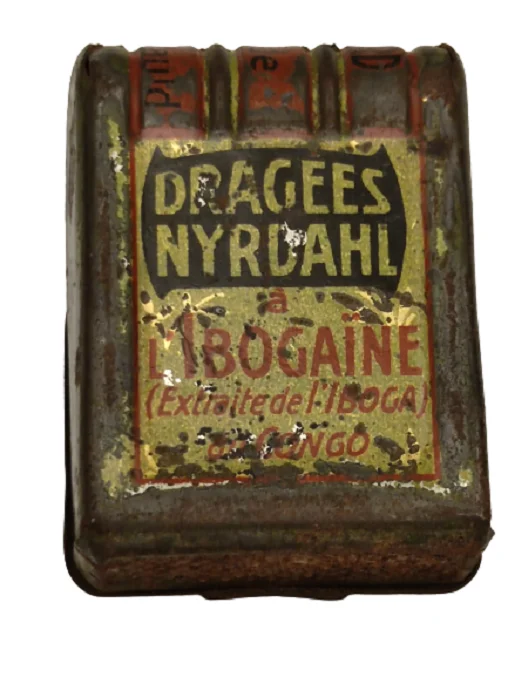
One mixup worth flagging: there was also an "Élixir de Virginie Nyrdahl," a separate product under the same brand name with no connection to ibogaine. A bottle labeled just "Nyrdahl" doesn't tell you which product it is.
Viris Lucet, Grains des Anémiques, Ibobiose: Three Early Iboga Tonics
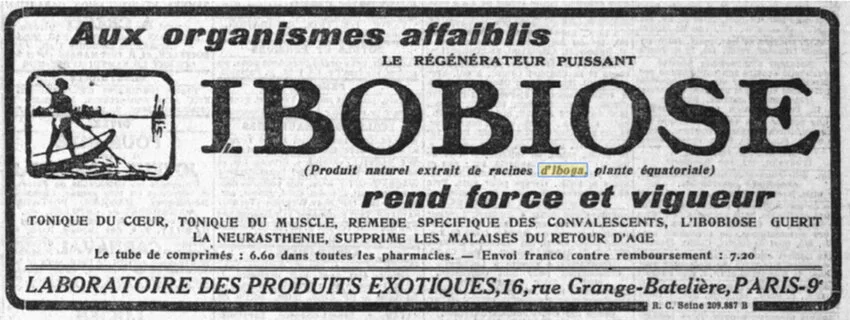
Between Nyrdahl and Lambarène, at least three more brands advertised iboga as an active ingredient. Viris Lucet appears in a 1913 ad in the French publication Jean qui rit. Grains des Anémiques shows up in Le Petit Havre on June 3, 1920, explicitly referencing iboga. Ibobiose ran in two different outlets in 1924: Le Petit Parisien in February and, notably, the sports publication L'Athlète in April, positioning it as a product for stamina and physical performance rather than general fatigue.
None of these brands have confirmed dosages or purity data attached to them in the historical record. What the ads do confirm is that by the early 1920s, iboga extract had become enough of a known commercial ingredient that multiple manufacturers were putting it in competing tonics, marketed to general readers and athletes alike, more than a decade before anyone had heard of Lambarène.
Syséros: An Iboga Pharmaceutical With a Date Problem
Syséros (sometimes spelled Syseros) is the brand with the most tangled paper trail. Ads from November-December 1937 and March 1938 market it as an aphrodisiac, well before the commonly cited 1960 figure for its origin. On the other end, sources disagree about when it left the market: the original 2026 study cites 1997 based on correspondence with France's drug regulator ANSM, a 2014 pharmacy dissertation by A. Béal gives 1998, and a historical drug-record mirror site lists the marketing authorization as AMM 310304-8, granted July 5, 1955, with September 1, 1993, recorded as the date commercialization ceased ("arrêt de commercialisation") for that presentation.
We're not going to pick one of those three dates and present it as settled. What we can say with more confidence: one account describes the composition as iboga extract combined with strychnine, and the product was still a marketed pharmaceutical well into the 1990s under any of the three cited end dates.
Iperton and Difa: The Brand With an Actual Chemistry Paper Behind It
Most of the brands above exist only as advertisements. Iperton/Difa is different: a 1976 analytical chemistry paper by Bertol, Mari, and Froldi, published in the Journal of Chromatography, describes a method for detecting ibogaine in biological fluids, which means someone was testing for it in a real pharmaceutical context, not just advertising it. A 2007 pharmacy dissertation by Loïc Sanner describes the formulation as Tabernanthe iboga extract combined with belladonna and calcium fructose-1,6-diphosphate. Separately, Ona and Marie cite the 1976 Bertol et al. paper for a figure of roughly 1.5 mg of ibogaine per tablet, a number that hasn't been independently reverified against the original full text.
Worth a warning here: a modern product also called IPERTON exists today in Greece, containing enalapril and hydrochlorothiazide, standard blood pressure medications with zero connection to the historical ibogaine brand. Same name, completely different drug, seven decades apart.
What the Ads Prove, and What They Don't
Seven brand names, advertised across at least four countries, spanning 1903 to somewhere in the 1990s: that's the commercial footprint the historical record actually supports. What it doesn't support is a cleaner story. None of these products have confirmed, consistent dosing across their full run. None of the advertised medical claims, neurasthenia relief, stamina, libido, were tested against anything resembling a modern clinical trial. Early animal experiments by Pouchet and Chevalier raised toxicity concerns in 1904-1905, shortly after Dragées Nyrdahl first appeared in advertisements.
Advertising from this era tells you what a manufacturer claimed and sometimes what was actually in the product. It doesn't tell you how well any of it worked, and it says nothing about safety by today's standards. QT interval prolongation is a documented cardiac risk that none of these 20th century tonics screened for, because the underlying cardiac pharmacology wasn't understood yet. The protocols that matter now, cardiac screening, physician supervision, lab-verified dosing, exist precisely because the unsupervised era this history describes carried real risk that nobody was measuring at the time.
The deeper point the research makes is one worth sitting with: ibogaine's story in the West didn't start with addiction treatment, and it didn't start with Lambarène either. Period advertisements document iboga tonics on pharmacy shelves in France, Brazil, and Mexico from 1903 onward, nearly six decades before Howard Lotsof accidentally discovered its anti-addictive effect in 1962. The compound spent most of the 20th century as a commercial tonic before anyone asked the question that eventually mattered most.
Sources
Genís Ona, Sidsel Marie, "The long roots of ibogaine: A journey from plant to pharmaceutical," Journal of Psychedelic Studies 10 (2026), 222-241, DOI 10.1556/2054.2026.00491; Wellcome Collection, catalog reference 11667i; Société d'Histoire de la Pharmacie (André Frogerais, 2018); BIAM historical drug record, SYSEROS; Loïc Sanner, pharmacy dissertation, Université de Lorraine, 2007; A. Béal, pharmacy dissertation, Nantes, 2014; Bertol, Mari, Froldi, Journal of Chromatography, 1976, PMID 1249155; Biblioteca Nacional do Brasil, Hemeroteca Digital.